Insight settings
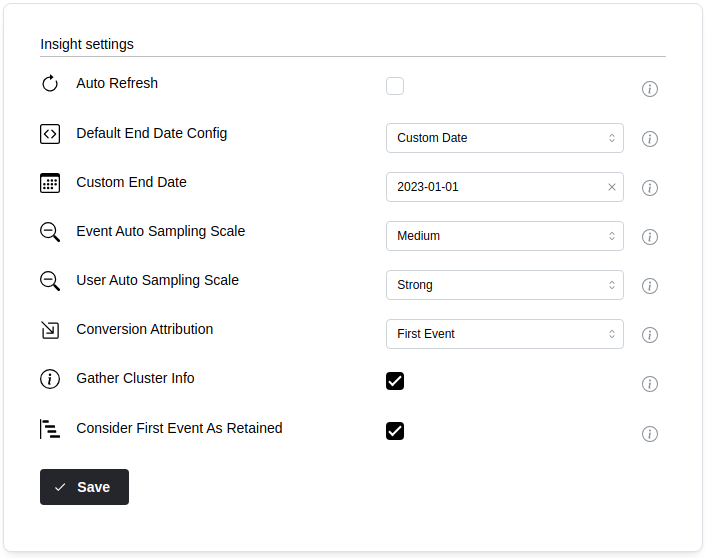
The Insight settings tab controls how new insights behave in this workspace — how dates are shown, how funnels and retention count events, and how Mitzu talks to your warehouse from the Insights page. Changes apply to every member of the workspace and are saved automatically.
Performance-related options (sampling, resolution, "first period" filter) now live on the Performance settings tab. AI options live on the AI settings tab.
Workspace display
Presentation defaults applied to every insight, chart, and dashboard.
- Default entity: The entity (for example User, Account, Session) that insights count by default. The Insights page uses this when an insight doesn't specify one. You can add or rename entities on the Entities tab.
Default date range
Controls the end date that every new insight starts with. The start date is always expressed relative to this end date (for example "last 30 days").
-
End date mode: How Mitzu picks the end date for new insights.
Mode Use it when Start of the current day Your pipeline lands yesterday's events once per day. Picks today at 00:00. End of the current day Events are loaded near real-time or in frequent batches. Picks today at 23:59:59. Now Events are loaded near real-time and some events may be stamped with future timestamps that you want filtered out. Custom date The dataset is frozen (for example a discontinued project). Use with Fixed custom end datebelow. -
Fixed custom end date: Pins every new insight to this exact date. Only enabled when End date mode is
Custom date.
Funnel & retention defaults
How Mitzu matches a user's events to each step of a funnel or retention chart.
-
Conversion attribution (funnels):
First: only the user's first matching event at each step counts. Fast, conservative, recommended for most use cases.Every: every matching event at every step counts. More permissive (and more expensive to compute).
-
Retention attribution (retention):
First: only the first retaining event per user in each period is counted.Every: every retaining event is counted.
-
Loose timestamp comparison (formerly "Allow same-timestamp conversions"): allow a 1 minute grace period when comparing the order of events, so a step can happen up to 1 minute before the previous step and the user is still counted as converted. Pick which insight types it is turned on for by default:
Off: no grace period anywhere.Funnels & Journey only: on for funnels and journeys, off for retention.Retention only: on for retention, off for funnels and journeys. This is the default for new workspaces.All: on for funnels, journeys, and retention.
This only sets the default. Every chart has its own Loose timestamp comparison checkbox in the conversion window menu, which overrides the workspace setting. Switching a chart to another insight type re-applies the workspace default for that type.
warningIf the same event is used at every step of a funnel or retention chart, one event can satisfy every step at once, inflating conversion. On a retention chart whose two steps are identical this makes
Day 0/Week 0/Month 0100%, because the initial event already counts as the return — see what it does to period 0. Keep this off for insight types whose steps use the same event. -
Retention base:
Eligible users(the default) counts a user towards a retention period only once that period has fully elapsed for them, so in 7-day retention a user who signed up two days ago is left out of the Day 7 base instead of counting as not returned.All userskeeps every user in the base for every period. Each chart can override it in its Retention period menu. See Retention base. -
Funnel base:
All users(the default) counts everyone who entered a funnel in the date range, so a user who entered two days ago and has not converted counts as not converted in a 7-day funnel.Eligible userscounts a user only once the full conversion window has passed since they entered, and leaves the rest out of every step. This is the default for new funnels; each chart can override it in its Conversion window menu, and saved funnels keep the base they were saved with. See Funnel base. -
Show incomplete periods: retention periods that are still in progress are drawn dotted and marked with
*by default. Turn this off to leave them out of new retention charts; each chart can override it in its More menu. See Incomplete periods.
Filtering & chart defaults
Small behavioral defaults applied to every new chart.
-
Case insensitive filtering:
Chrome,chrome, andCHROMEmatch the same events. When this is off, filters are case-sensitive. -
Fill missing values with zero: shows a zero bar instead of an empty slot for categories that produced no events. Applies to segmentation charts only.
-
Any event (experimental): adds a synthetic "Any event" entry to your event catalog that matches every event in the workspace. Useful for cross-event funnels like "did anything after sign-up". Recommended only when you have a single event table — with many event tables, "Any event" expands to a large OR-query that can be slow.
Querying & monitoring
Controls how Mitzu runs queries against your warehouse from the Insights page.
-
Gather cluster info: collects cluster status alongside each query to help troubleshoot slow queries and visualize progress. Only has an effect on Snowflake, Databricks, BigQuery, Trino, and Redshift.
On Redshift the "other queries running" count only includes queries run by the same warehouse user Mitzu connects as, because
SYS_QUERY_HISTORYshows a non-superuser only their own rows. Connect as a superuser to see cluster-wide load. Cancelling a running query from Queries is not supported on Redshift.
Changes are saved automatically.