Event Property Catalog
The event property catalog helps you track and document the properties of all events in your data warehouse.
Event properties are added and removed automatically when you add or remove an event table. You cannot create or remove them manually.
Use cases
Maintaining the display name and description fields of the event property records can help you:
- map technical abbreviations and raw property names to human-readable labels
- explain the meaning of an event property with a description
All features
Listing event properties in the catalog
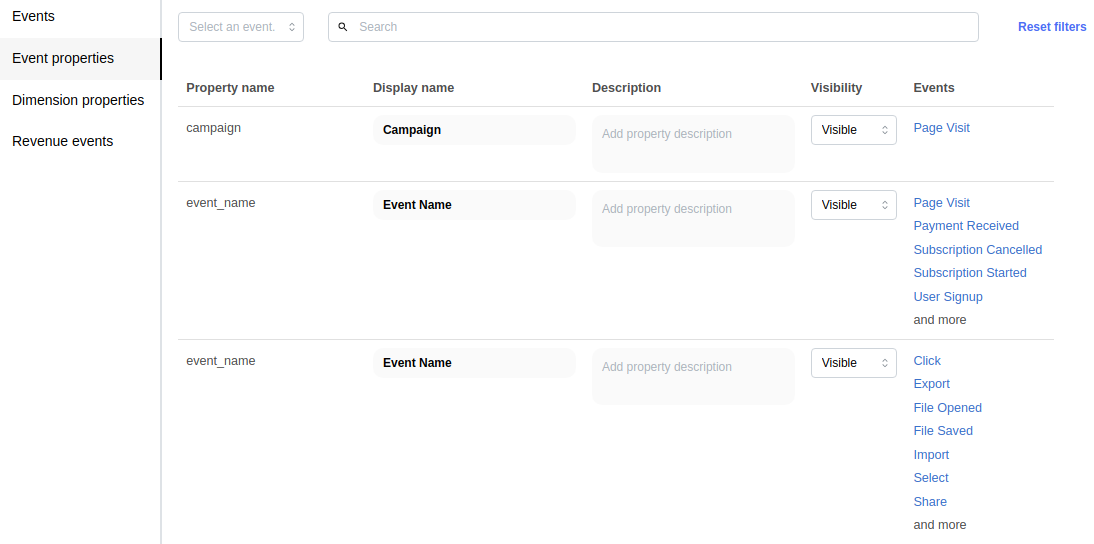
The Event Properties tab on the catalog page lists the event properties stored in the catalog of the selected workspace.
All event properties are listed only once, even if multiple events have properties with the same name.
The table contains the following columns:
- Source: This is the column name of the event data table. The column name uses the
<column name>.<field key>format if the event property is a nested data structure (e.g., struct, JSON). - Display name: The display name used to reference the event property on the Insights page and in charts, dashboards, and tooltips.
- Description: The description can help you find a suitable event when browsing the Insights page.
- Visible: You can control which event properties are visible on the Insights page. Clear the checkbox for a property and you won't see it listed in any dropdowns. Insights that already use this field won't break, but they cannot be recreated. The analytics agent leaves hidden properties out of its suggestions too. It still uses one you name and says it is hidden; before using a hidden property you did not name, it asks you first.
- Events: Shows which events have this property. Only the first five events are listed; click
Show N moreto open a searchable list of every event carrying the property. Clicking an event, either in the column or in that list, narrows the page to the properties of that single event. The column is hidden once a single event is selected, since every row would then repeat that same event.
You can filter the table using the free text search input or by selecting an event in the All events dropdown. Both filter the list as you type or select, without reloading the page. Click Reset filters next to the dropdown to clear them all at once. Clicking the column headers sorts the list, and every property is listed on one page.
Updating display name, description
To change the display name or description of an event property catalog record, click the input field and enter the desired value. The catalog is updated once you stop typing.
Refreshing filter values and changing property data types
You can also refresh the filter values in the Event Properties tab. Click the Show values button at the end of a property's row. The property's data type (for example String, Number or Array of String) is shown next to the button. A property whose type differs between events shows Mixed.
The stored values belong to one property of one event, so the button is only active when the property resolves to a single event: either the property was discovered on exactly one event, or you selected an event in the All events filter. Otherwise the button is greyed out and its tooltip asks you to select a single event first.
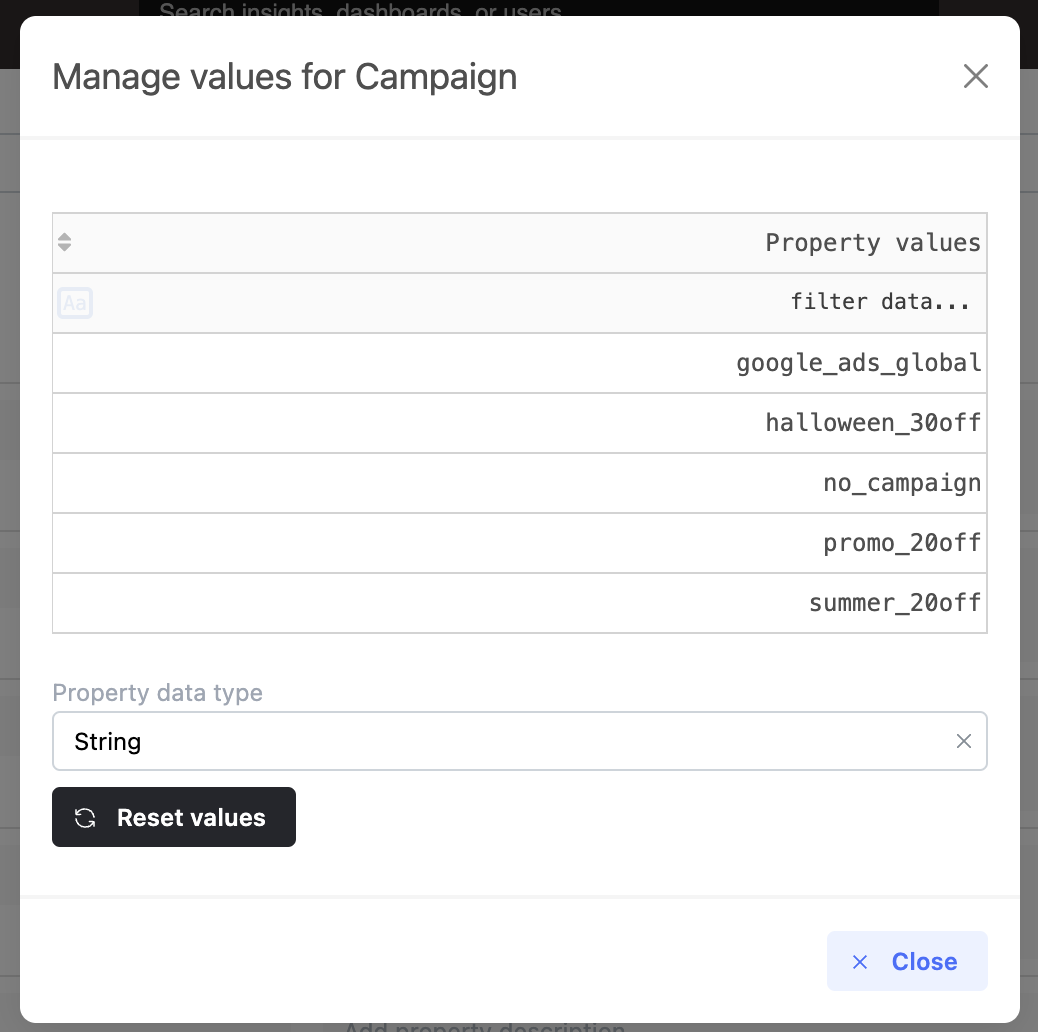
Here, you can refresh the possible filter values. You can also change the data type of any property.
Changing the data type may cause the generated SQL queries to stop working. Proceed only if you are sure the data type change is necessary.
Reading text columns as JSON arrays
Some warehouses store lists, such as product tags or item IDs, as JSON arrays serialized into a text column (for example ["sale", "new"]). Mitzu can read these columns as arrays.
In the Show values dialog of a text property, choose Array as the property data type, then pick the type of the array's elements in Array element type (String, Number or Bool). The option is offered for columns of the event table, not for keys nested inside JSON, map or struct columns. Mitzu then re-discovers the values right away, so the value list shows the distinct elements (sale, new) instead of every distinct combination.
Once a property is read as an array:
- Filters offer the array operators:
array contains,array not contains,array likeandarray not like. - Rows holding an empty array, no value or text that is not a JSON array are read as empty arrays.
- Only flat arrays of strings, numbers and booleans are read.
nullelements are skipped, and nested arrays or objects are not supported.
The setting belongs to the column, so it applies to every event of the event table that has this property, and it is kept when the table is re-indexed. Choose String again to read the column as plain text.
Insights that already break down by the column, hold it constant in a funnel or aggregate it keep reading the raw JSON text, such as ["sale", "new"], so their labels and legend renames don't change.
Reading text columns as JSON arrays is available on PostgreSQL, ClickHouse, Trino, Athena, BigQuery, Databricks and Snowflake.