Licenses, org roles and members
Invite colleagues and business partners to your Mitzu organization so they can share insights and dashboards, or analyze your company data themselves. Everything on this page happens on Settings → Organisation → Members, which only Org Admins can open.
For how many Org Admins to have and who should manage each workspace, see Recommended setup.
Seat allocation
Above the members table, the Seat allocation card shows how many editor seats are in use compared to your plan. Everyone with an Editor license uses an editor seat, whatever their org role; Viewer licenses are free and don't count against the limit. If you exceed your purchased seats, Mitzu shows an Editor seats exceeded warning — move people to a Viewer license or click Manage subscription to increase your plan.
Licenses and org roles
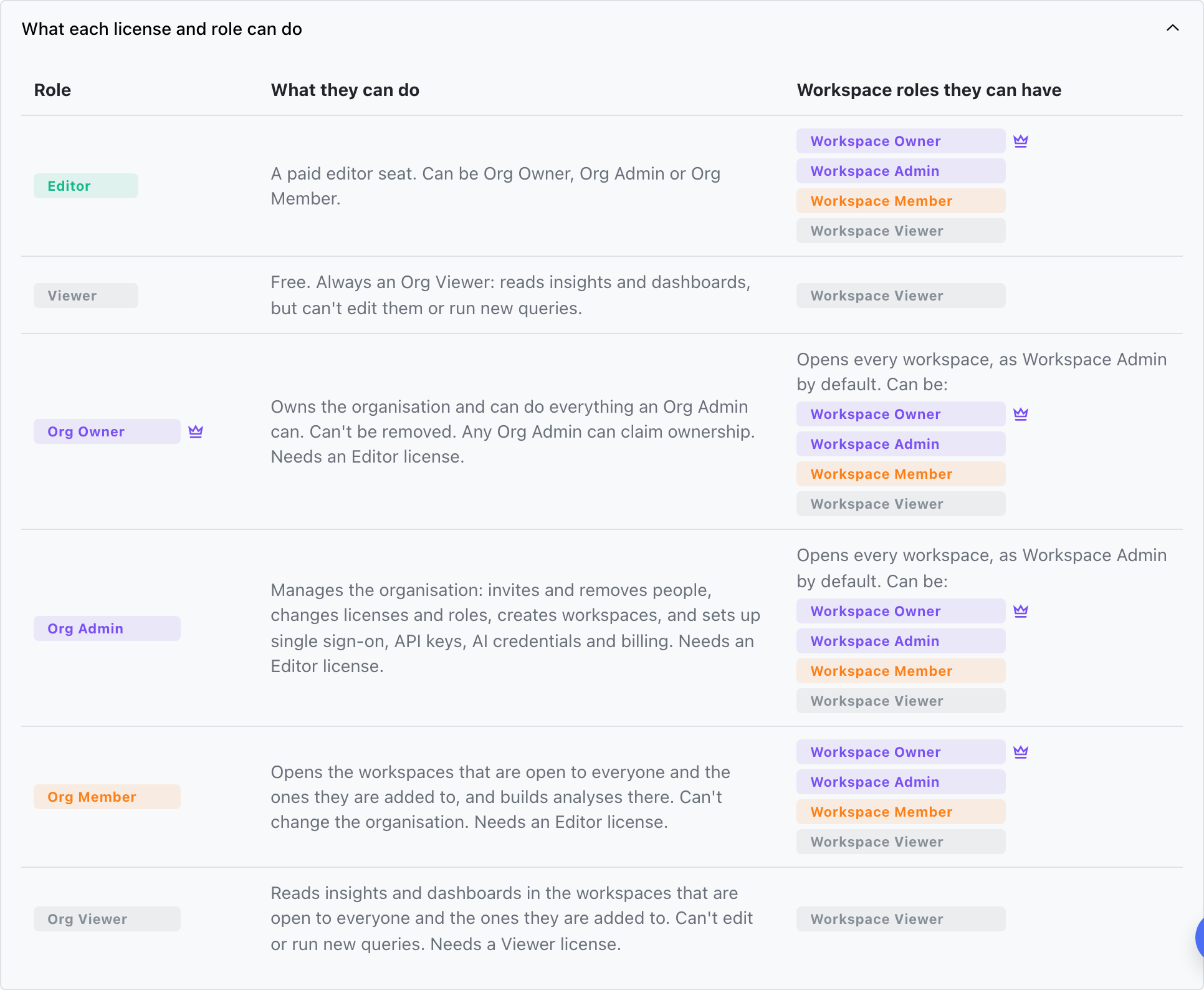
Everyone in the organization has a license and an org role. The license decides whether they can create and edit content at all. The org role decides whether they can change the organization. What each license and role can do, above the members table, explains each one and lists the workspace roles it can have.
Licenses
The license is the first thing to set. It matches the two license types on your subscription.
| License | What it allows | Org roles it can have |
|---|---|---|
| Editor | A paid editor seat. Creates and edits content. | Org Owner, Org Admin or Org Member |
| Viewer | Free. Reads insights and dashboards, but can't edit them or run queries on the data warehouse. | Org Viewer only |
Org roles
| Org role | What they can do | Workspace roles they can have |
|---|---|---|
| Org Owner | Owns the organization and can do everything an Org Admin can. Can't be removed and their license and org role can't be changed. Any Org Admin can claim ownership. | Opens every workspace, as Workspace Admin by default. Can be Workspace Owner, Workspace Admin, Workspace Member or Workspace Viewer. |
| Org Admin | Manages the organization: invites and removes people, changes licenses and roles, creates workspaces, and sets up single sign-on, API keys, AI credentials and billing. Needs an Editor license. | Opens every workspace, as Workspace Admin by default. Can be Workspace Owner, Workspace Admin, Workspace Member or Workspace Viewer. |
| Org Member | Opens the workspaces that are open to everyone and the ones they are added to, and builds analyses there. Can't change the organization. Needs an Editor license. | Workspace Owner, Workspace Admin, Workspace Member or Workspace Viewer |
| Org Viewer | Reads insights and dashboards in the workspaces that are open to everyone and the ones they are added to. Can't edit or run new queries. Needs a Viewer license. | Workspace Viewer |
Org Viewers see cached results, and a "You don't have permission to run queries" notice when a result is not cached yet. The license and the Org Viewer role always go together: a Viewer license is always an Org Viewer, and an Editor license is never one.
See Workspace access for the workspace roles, what each role can do, and how changing a license or org role affects workspaces.
Listing members
Existing members are shown in a table with the following columns:
- User email — the email address the member uses to sign in to Mitzu. Your own row shows your email in bold with a You badge.
- Sign-in — Email or SSO. SSO means the member signs in through your configured identity provider (see Single Sign-on).
- License — Editor or Viewer. See Licenses. You can change it right in the table: click the badge and pick the other one. Switching to Viewer makes the member an Org Viewer, and switching to Editor makes them an Org Member.
- Org role — Org Admin, Org Member or Org Viewer. The Org Owner's role has a crown next to it; hover it to see what ownership means. See Org roles. You can change it right in the table too, by clicking the badge; an Editor license offers Org Admin and Org Member, and a Viewer license only offers Org Viewer.
- Devices (7d) — the number of distinct devices the member has signed in from over the last 7 days. Useful for spotting shared or unused accounts.
- Workspaces — the workspaces the member can open, the ones where they are Workspace Owner or Workspace Admin, and, for Org Admins, the ones where they have a lower role. See Workspace access.
A license or org role that can't be changed shows as a plain badge without a dropdown arrow: yours, the Org Owner's, and the org role of anyone with a Viewer license. Hover it to see why.
The table shows 15 people per page, ordered by org role: the Org Owner first, then Org Admins, Org Members and Org Viewers. Admins are purple, members orange and viewers gray.
Click the User email, License, Org role or Devices (7d) header to sort the table. Sorting by License lists Editors first; sorting by Org role lists the Org Owner and Org Admins first, then Org Members, then Org Viewers. Click again to reverse the order. The row under the headers filters every column: type in User email or Workspaces, or pick a value for Sign-in, License or Org role. Filtering, sorting and paging happen instantly in your browser. The checkbox in the header selects every row that matches the filters.

Invite new members
To invite new members, click Invite. The Invite users dialog opens, where you enter a list of email addresses and pick their License (Editor by default) and Org role (Org Member by default). Picking a Viewer license sets the org role to Org Viewer; an Editor license offers Org Admin and Org Member. Click Invite to send the invitations — each address receives an invitation email.
You can invite up to 10 email addresses at once.
Invited people can open every workspace that is open to the whole organization. To give them restricted workspaces too, pick them in Also add to restricted workspaces: they join those as Workspace Members, or as Workspace Viewers if they are Org Viewers. If adding them to a workspace fails, the invitation is still sent and the dialog reports the workspace part on its own. Approving a join request asks for the same license, org role and restricted workspaces.
People who join through single sign-on get an Editor license and the Org Member role.
If SSO is enabled, you do not need to invite users that already exist in your identity provider — they can sign in directly. When you do invite them, the invitation email links straight to your identity provider's sign-in page. People invited with Invite as external user get a link to create an email and password account instead.
Only Org Admins can invite new members.

Update a member
To change a member's license or role, select the member's row via its checkbox and click Manage. A dialog opens where you can pick the member's License, Org role and, under Workspace roles, their role in each workspace; click Update to apply it. See Workspace access for what each workspace role allows.
An Org Admin is a Workspace Admin in every workspace unless you pick Workspace Member or Workspace Viewer for a workspace; they can't be given No access. Making someone an Org Admin resets their workspace roles to Workspace Admin everywhere, and the workspace roles picked in the same dialog are ignored, so lower them afterwards if needed.
You cannot change your own license or org role, or the Org Owner's. To change the Org Owner's, another Org Admin first has to claim ownership. A Viewer license is always an Org Viewer and an Editor license never is, so switching someone's license to Viewer makes them an Org Viewer, and switching it to Editor makes them an Org Member.
Any Org Admin can change licenses and org roles, but the organization always needs at least one Org Admin.

Remove a member
To remove a member, select the member's row via its checkbox and click Remove. The Remove users dialog appears — click Delete to proceed.
The member's dashboards, insights, cohorts, scheduled agents, alerts and other content in each workspace are transferred to that workspace's Workspace Owner. Workspaces they owned go back to the Org Owner, together with their content there.
You cannot remove the Org Owner or your own user.
When SSO is enabled, members authenticated by your identity provider can be removed, but nothing stops them from signing in again and re-joining on their next login.

Organization owner
Every organization has one Org Owner. At first it is the person who created the organization. The Org Owner is an Org Admin with an Editor license who can't be removed and whose license and org role can't be changed. They are also the Workspace Owner of every workspace that hasn't been handed over to someone else, so content from people who leave those workspaces is transferred to them.
Any Org Admin can take over ownership, for example when the Org Owner leaves the company. Click Claim ownership above the members table and confirm in the dialog. You become the Org Owner and the Workspace Owner of the workspaces that hadn't been handed over. The previous Org Owner stays an Org Admin with the same access, and receives an email about the change.
Only Org Admins can claim ownership. The button is hidden for the current Org Owner.