Cohorts
In product analytics, understanding user behavior is pivotal to driving engagement, retention, and overall success. Cohorts let you isolate a specific group of users — or any other entity — and reuse it across your insights. By grouping users based on shared attributes or behaviors, you can tailor your analysis and build more focused, comparable views of your data.
What are cohorts?
A cohort is a saved group of one entity. By default that entity is your users, but if your project has other entities (for example accounts or teams), you can build a group of those too. A group of a non-user entity is called a collection, and you will see this wording throughout the app — for example Create account collection instead of Create cohort. Cohorts and collections live together under Data → Cohorts & Collections.
There are three kinds of cohort, distinguished by how the members are determined:
- Dynamic — defined by the criteria of an insight (the events, filters, and date range you built in Explore). The membership is recalculated each time the cohort is refreshed, so it always reflects the current data.
- Imported — a fixed list of users uploaded from a CSV file. The membership stays exactly as imported until you replace it.
- Lookup — built from an entity lookup search on entity properties.
Example cohorts you can create
- Geographic cohorts: Group users by their location, for example everyone in a specific country or region, to tailor your strategies accordingly.
- Engagement-level cohorts: Group users by how often they interact with your product within a period. This helps you identify your most active users and understand what keeps them coming back.
- Acquisition cohorts: Group users by when they first signed up or made a purchase. Analyzing these cohorts over time reveals insights into retention and the long-term value of different segments.
- Behavior-based cohorts: Group users by a specific action they have taken, such as completing a purchase, sharing content, or reaching a milestone. This helps you understand how different behaviors correlate with retention and satisfaction.
Benefits of using cohorts
- Enhanced user understanding: Gain deeper insight into how different groups interact with your product.
- Improved product development: Identify the features and content that resonate with each group.
- Optimized marketing efforts: Tailor campaigns to the needs of each cohort.
- Data-driven decisions: Make informed decisions based on clear insights into user behavior.
Creating cohorts
You can build a cohort three ways: from a chart in Explore, from a CSV file, or from the entity lookup. The analytics agent can also create one for you from a natural-language request.
From a chart
Any data point on an Explore chart can become a cohort of the users behind it.
- In Explore, build a Segmentation, Funnel, Retention, or Journey insight.
- Make sure an entity is set under Analyze uniques by — a cohort always groups one entity, and your users are selected by default. Without an entity the Create cohort action stays disabled, with a hint to pick one.
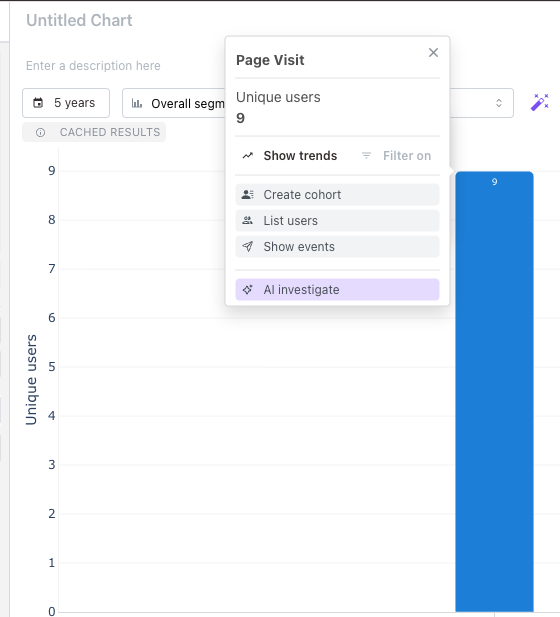
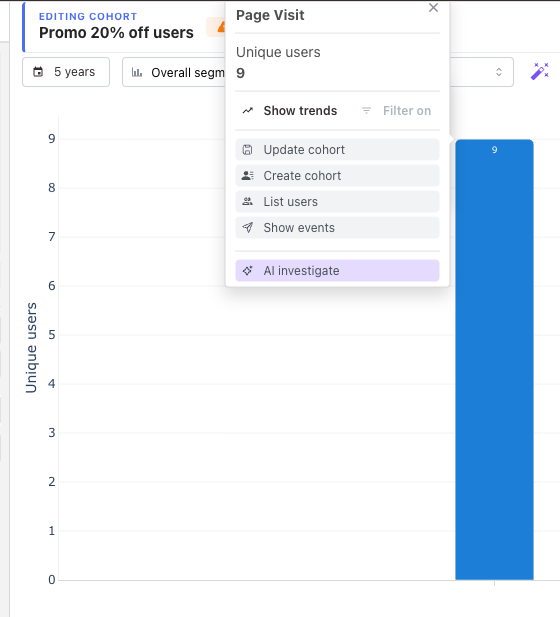
- Run the insight, then click the data point you want: a bar, a funnel step, a retention cell, or a journey node.
- In the menu that appears, choose Create cohort. For a non-user entity the action is named after that entity — for example Create account collection.
- Give the cohort a name and click Create cohort. You can also pick Add to existing to merge the selected users into a cohort you already have.
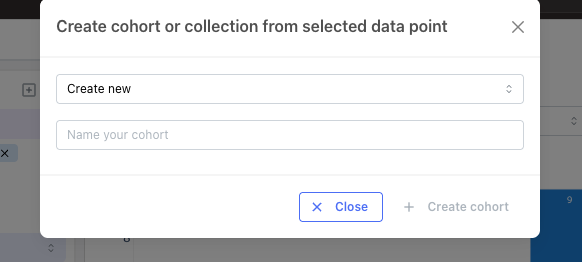
The cohort captures the exact definition behind that data point — the events, filters, breakdown value, and date logic — as a dynamic cohort.
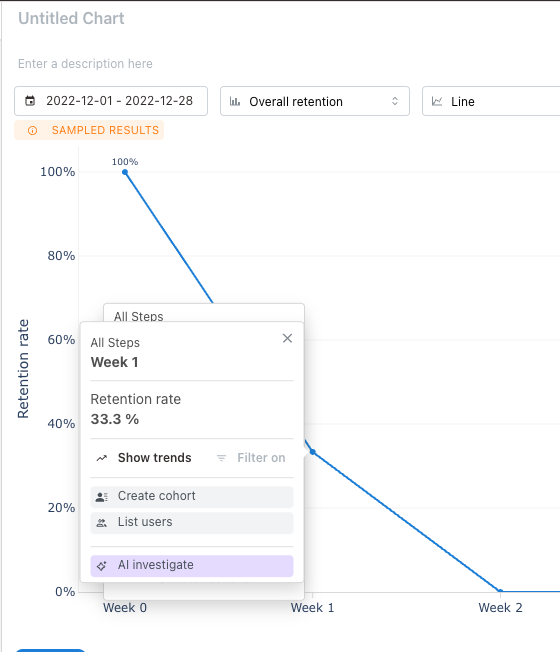
Cohort creation is available on Segmentation, Funnel, Retention, and Journey charts. For example, clicking a point on a retention curve creates a cohort of the users counted at that step. It is not available on comparison charts, because a comparison point spans two date ranges.
From a CSV file
If you have a list of users exported from another tool, you can upload it as an imported cohort. In the top navigation, open the Create menu and choose CSV Collection.
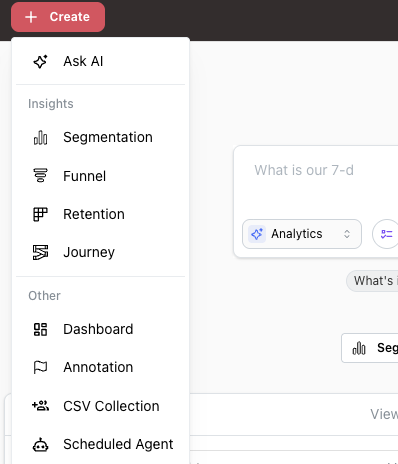
Format requirement: the CSV file must contain a single column labeled user_id, with each subsequent row containing one unique user_id.
From the entity lookup
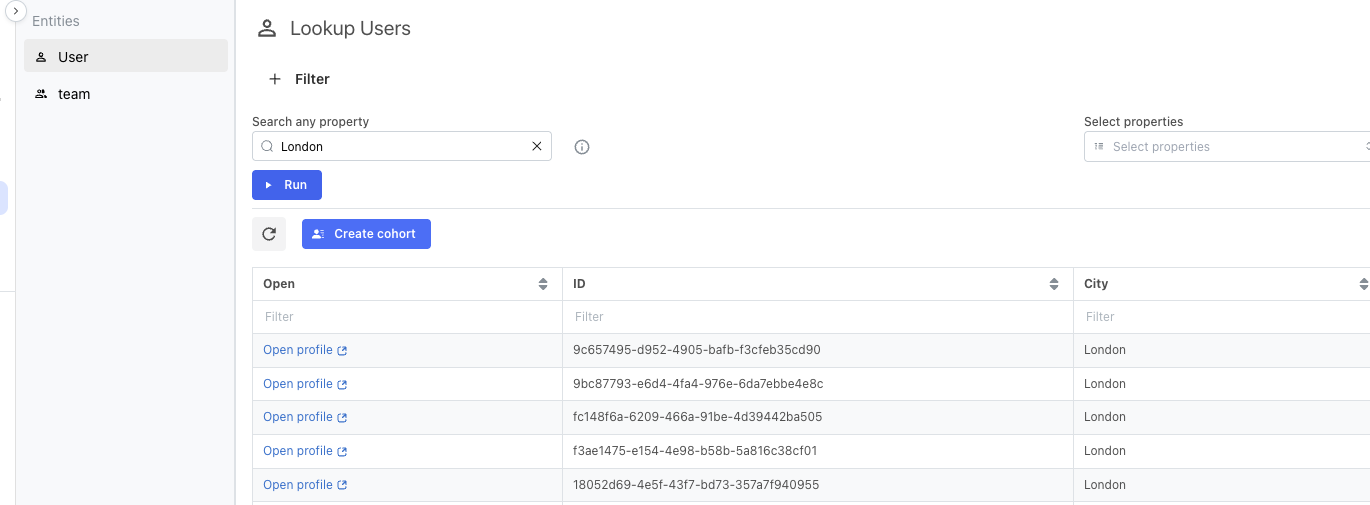
You can also turn an entity lookup result into a cohort. Search users or groups by their properties, then click Create cohort above the results to save everyone matching the search.
Editing and updating cohorts
How you change a cohort depends on its type.
Dynamic cohorts
A dynamic cohort is not a stored user list but the set of criteria that defines the group. You can edit those criteria directly in Explore.
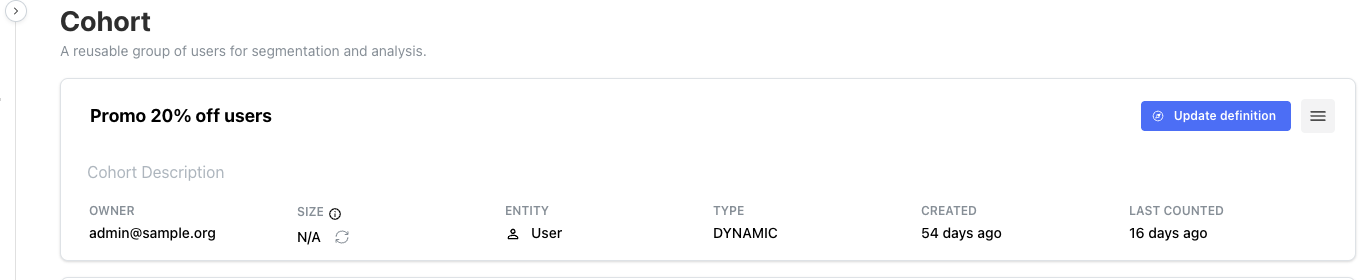
Open the cohort from Cohorts & Collections and click Update definition. This opens the cohort's insight in Explore in cohort-edit mode.
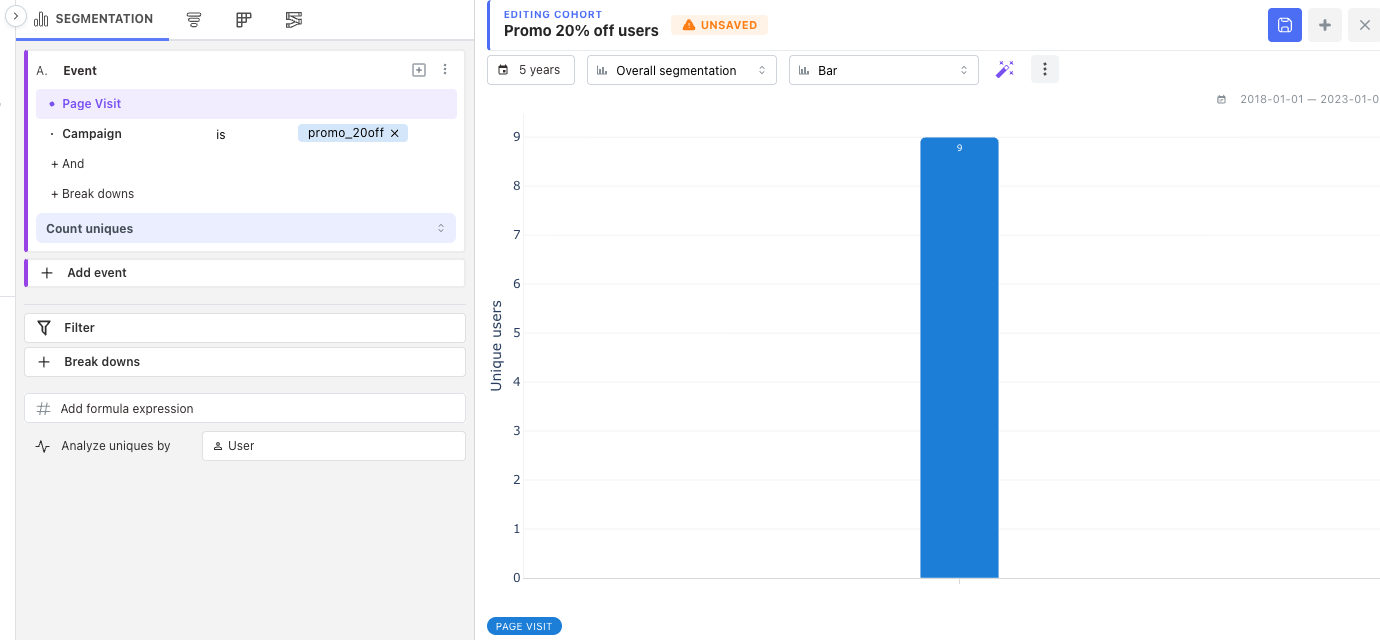
In cohort-edit mode a ribbon replaces the usual insight header. It shows which cohort you are editing, a Saved / Unsaved indicator, and three actions:
- Update writes your changes back to the cohort in one click.
- Save as new keeps the original cohort untouched and creates a separate one from the current definition.
- Exit leaves cohort-edit mode and keeps the current chart open in Explore as a regular insight. If you have unsaved changes, it asks you to confirm first. (To go back to the cohort's page instead, click the cohort name in the ribbon.)
Update stays available as long as your edit still maps cleanly back to a single group — same insight type, same number of segments, an entity set, and no breakdown. If you change the shape of the insight (add a breakdown, drop the entity, or change the structure), Update is disabled and a hint points you to the chart instead: click the exact group you want, then choose Update cohort from the data-point menu to repoint the cohort at that selection.
To recalculate a dynamic cohort's size without changing its definition, open the cohort and use the refresh control next to Size.
Imported cohorts
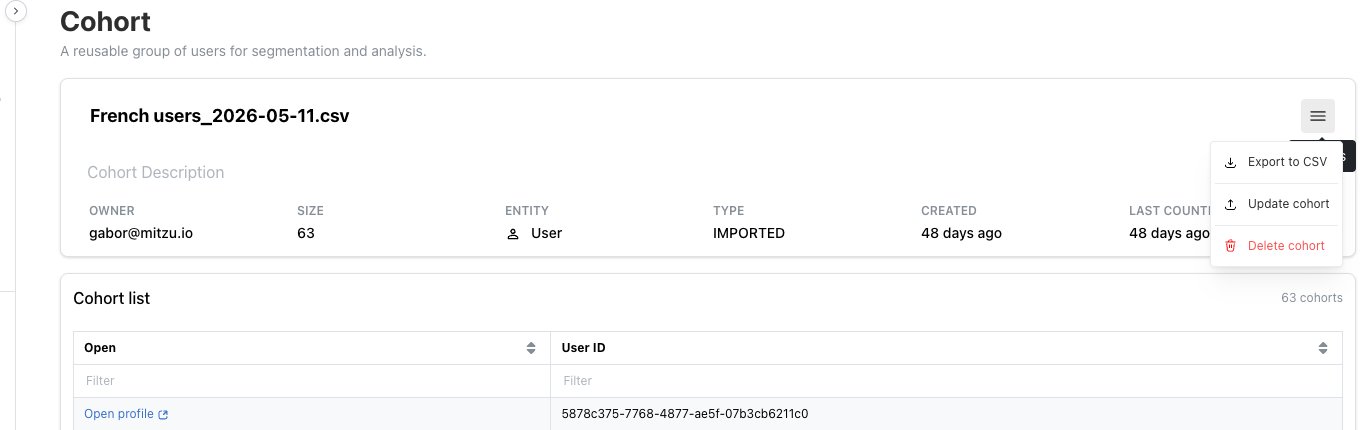
You can edit an imported cohort's name and description at any time. To change the members, open the cohort, choose Update cohort from the actions menu, and upload a new CSV file. The new list replaces the existing one in place.
Lookup cohorts
To change a lookup cohort, open it and click View Lookup to return to the entity lookup with its search applied, then refine the search.
Using cohorts in insights
A saved cohort becomes a reusable filter, so you can narrow any segmentation, funnel, retention, or journey to the users who are in — or out of — that group.
Add a filter and pick Cohort (it sits at the top of the filter list). Each cohort condition has an operator and one or more cohorts.
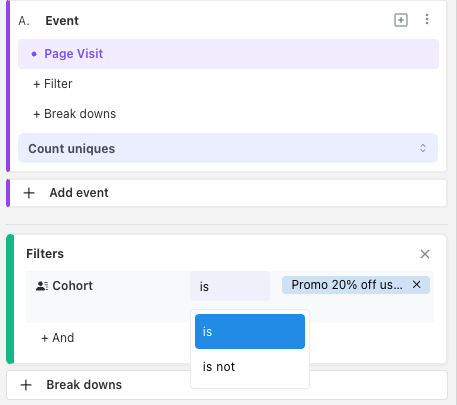
- Membership —
iskeeps only the users who belong to the cohort. Add several cohorts to oneiscondition to keep users who are in any of them (a union). - Non-membership —
is notremoves the cohort's users from the insight. This is the way to exclude a control group, churned users, or an internal/staff cohort.
Conditions are combined with And, so you can layer them to carve out a precise segment — for example Cohort is Power users and Cohort is not Trial users isolates engaged paying users. The same pattern builds frequency or recency bands: keep everyone in the broader cohort and exclude the narrower one. Cohort conditions sit alongside any event or property filter, so you can mix them freely.
Cohort details
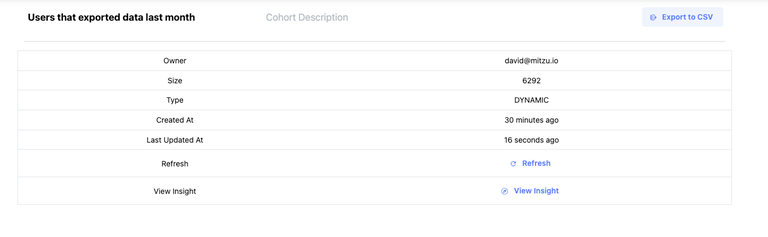
You can find the details of a cohort on its page. Navigate to Cohorts & Collections under the Data menu and click the name of the cohort you want to review. The following information is displayed:
- Size — with a refresh control for dynamic cohorts
- Entity
- Type (Dynamic, Imported, or Lookup)
- Created at
- Last counted
- Update definition — dynamic cohorts only
- View Lookup — lookup cohorts only
- The member list — imported cohorts show their uploaded users
The cohort's owner is shown at the top of the Actions menu, with their name and email.
Export cohorts
To export a cohort to CSV, open the cohort and click Export (or Export to CSV in the actions menu).